
What Makes a High Jewellery Watch Worth Millions? Inside Vacheron Constantin, Tiffany & Antoine Preziuso
 4 min read

You would think that understanding a true high jewelry watch meant simply marveling at the diamonds and the beauty of it but is that really the case? After hours of understanding what it takes for such a timepiece to be made I have recently learned that in order to truly appreciate high jewelry watches you must do something incredibly counterintuitive: stop looking at the stones, and start looking for the metal or rather you could say, the complete lack of it. In my observation of haute joaillerie, I've realized the true value isn't measured simply by carat weight, but by the breathtaking illusion of the setting that requires endless hours to achieve. Techniques like invisible and snow setting are notoriously difficult, requiring hundreds of hours of labour, microscopic precision, and the constant risk of shattering priceless stones. As an observer of fine horology, I see these creations not merely as luxury goods, but as masterclasses in extreme metallurgical engineering and stone-cutting. To know more about the art of gem setting in Luxury watches, click here.
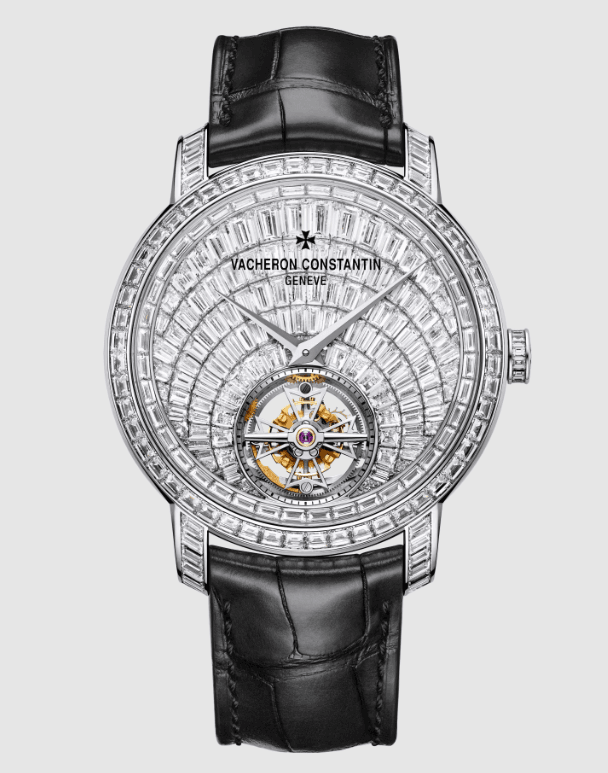
The Illusion of Seamlessness: Vacheron Constantin Traditionnelle Tourbillon High Jewellery
The "invisible setting" sounds like a metallurgical magic trick and it is exactly that. It involves the agonizing process of carving microscopic, hidden grooves into the pavilion of the stones, such as the 160 baguette-cut diamonds framing this Vacheron Constantin case, and the 158 paving its dial so they can slide onto a hidden metal rail system. Just one millimeter of miscalculation, and the stone splinters. In the Traditionnelle tourbillon high jewellery, Vacheron Constantin uses this exacting technique to create a flawless, unbroken mirror of diamonds across the 41mm white gold exterior. This breathtaking, pristine canvas serves as a sterile, brilliant frame for the mechanical beating heart of the ultra-thin, self-winding Calibre 2160 tourbillon visible at six o'clock.
The Calculated Chaos: Tiffany 57
While Vacheron Constantin relies on the rigid discipline of straight lines, other Maisons find their brilliance in calculated chaos. Unlike traditional settings where uniform stones are placed in neat rows, a snow setting on the other hand requires the artisan to take stones of varying diameters and pack them together as tightly as possible, deciding the layout in real-time. When examining the Tiffany 57, this technique is on full display. The artisan uses 306 round brilliant diamonds to completely consume the 18k rose gold dial, and 309 more across the dome-shaped case. The goal is to leave zero negative space, mimicking the organic, unpredictable way fresh snow settles on a city street. Accompanied by a crown set with custom-cut baguette diamonds, the result is a timepiece that feels inherently alive and distinctly textural.

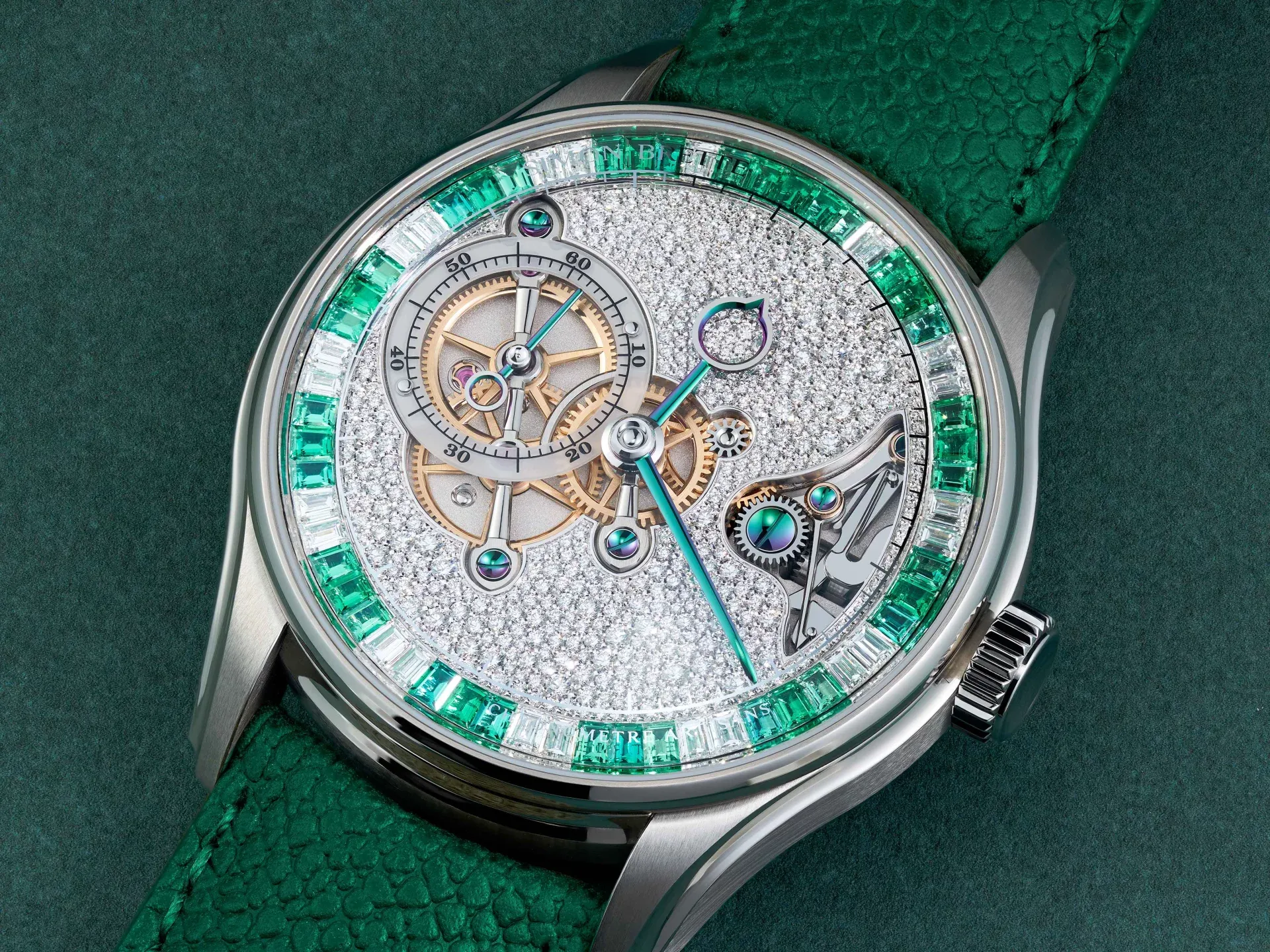
The Duality of Discipline: Simon Brette Chronomètre Artisans Joaillerie
There is an incredible tension in placing two vastly different setting philosophies right next to each other. This collision of techniques is perfectly executed by independent watchmaker Simon Brette in his bespoke Chronomètre Artisans Joaillerie editions. This piece stands as the ultimate juxtaposition. The center of the dial features a chaotic, sparkling snow-set field of over 300 diamonds, which is then suddenly contained by a highly disciplined, invisibly-set outer ring of custom-cut colored gems, whether vibrant emeralds, deep black spinels and rubies, or amethysts. Adding to the allure, this dazzling traditional gem-work contrasts beautifully with hyper-modern ALD Atomic Layer Deposition technology, which gives the mechanical screws and hands an iridescent color gradient, shifting dramatically from green to violet depending on the light. Simon Brette uses these techniques to balance a classic dial, but when applied to a hyper-complex movement, the scale of the stone-cutting reaches terrifying proportions. To know more about how jewlerry watches have become popular click here.
The Boldness of Scale: Antoine Preziuso Radiant
What happens when stones are not merely decorative, but act as structural elements of the watch itself? The Antoine Preziuso Radiant answers this question with force. This watch is not just about paving a case, it is about framing a staggering mechanical achievement: a planetary triple-differential gear with three separate tourbillons. The sheer boldness of invisibly setting nearly 900 Top Wesselton baguette-cut diamonds across the 18-carat white gold case and bracelet is astonishing, but the custom-cut stones demand the most attention. The dial is defined by two massive solitary trillion diamonds that float gracefully beside the mechanics, while a pigeon blood red trillion-cut ruby acts as an indicator marking the ten-minute orbital rotation. It is brute-force mechanics matched by brute-force gemology.

When viewing these masterpieces, it is easy to be blinded by the finished product. However, I always bring my focus back from the radiant light of the finished watches to the dark, quiet workshops where they are made. The ultimate luxury of these pieces is not the millions of dollars in raw materials. It is the hundreds of hours of invisible, painstaking human labour that you are never meant to see. To read more about secret jewlery watches click here.


